What to Build First When Your Audience Spans Ages 8 to 25
AI tools have collapsed the timeline from months to hours, so start with the easiest genre first.

A creator with a real idea and a wide audience usually gets stuck on the same question: where to even start? The 8-to-25 range isn't one audience, it's a spectrum of attention spans, spending habits, and patience for complexity, and trying to design for all of it at once is where most first-time creators freeze up.
The design problem of an audience spanning ages 8 to 25
Picture the range laid out like a hallway, with an 8-year-old at one end and a 25-year-old at the other. The 8-year-old wants to be playing something fun in the next ten seconds. Younger players, roughly 8 to 12, want short feedback loops, simple controls, social play, and zero friction on the way in, because a long tutorial loses them before it finishes, phone or Chromebook already closed.
At the other end of that hallway, the needs flip. Players in the 16-to-25 band want mechanical depth, a reason to come back, and enough complexity to justify the time they're putting in. Giving them something shallow loses them fast, usually faster than the younger cohort, because they've got more games competing for the same hour.
The middle of the hallway, roughly ages 13 to 15, moves the most. This group is genre-curious and trend-driven, more loyal to whatever's culturally hot that month than to any specific type of game. A tycoon can be their favorite thing on a Tuesday and forgotten by Friday when something louder shows up on their feed.
Most early creators try to build one game that makes all three groups happy at once. That's a reasonable instinct and a bad plan. Stretch a single build across that much variance and the usual result satisfies nobody clearly: too simple for the 20-year-old, too demanding for the 10-year-old, and invisible to the 14-year-old who's already moved on to whatever's trending this week. The smarter path is picking one age anchor inside that range, finding genres whose mechanics scale beyond it, and only then checking whether building it is actually realistic right now. That last part used to be the hard part. It isn't anymore, and that's the assumption this piece needs to correct before anything else makes sense.
The barrier between a game idea and a published game shrank from months to hours
For years, "build a game" meant install an engine, learn Lua or an equivalent language, model your own assets, script every interaction, and test it all yourself, a process that could eat months before a single player ever touched it. That timeline was the real reason so many good ideas never left somebody's notes app.
The pipeline now runs differently. A creator describes the game in plain text. An AI layer takes that description and handles the design, the 3D building, and the scripting, with testing folded into that same build step on platforms like studs.gg. The result publishes straight from the browser, with nothing to install.
That browser-first detail matters more than it sounds like it should. A 12-year-old on a school Chromebook and a 22-year-old on a laptop with no spare storage have the exact same problem under the old model: nowhere to put a heavyweight engine install. Removing the install step entirely lets both of them go from idea to published game without ever hitting that wall. That's not a convenience feature. For a chunk of this audience, it's the difference between starting and never starting.
The obvious pushback: won't AI-built games just be shallow? Shallow games are a design failure, not a tooling limitation. The creative decisions that make a game resonate, a satisfying core loop, a mechanic worth repeating, a reason to stick around, are the same decisions a creator has always had to make by hand. The tool clears out the skill bottleneck. The idea still sets the ceiling. Which means the real question creators should be asking isn't "can I technically build this?" anymore. It's "which genre actually fits an audience this wide?"
The genre landscape mapped against the 8-to-25 range
No single genre owns the full 8-to-25 range. Some genres are just far easier front doors than others, and knowing which is which turns a vague creative decision into a usable framework.
Obbies are the cheapest end of the spectrum to build. No economy to design, no scripted AI enemies, nothing but a player's own skill against a course. That simplicity pays off on both ends of the age range: an 8-year-old doesn't need to understand a purchasing system to play one, and a 22-year-old will still grind a leaderboard time if the course is tight enough. For a first build, an obby is the fastest route from idea to live game, and it teaches a creator more about their own instincts than almost anything else they could start with.
Tycoons ask a little more of the builder but pay it back in retention. The idle-loop mechanic, where things grow or produce resources whether or not you're staring at the screen, works across the age range for different reasons: younger players like watching things collect and grow, older players like optimizing the economy underneath it. Tycoons are still beginner-friendly to design, just moderately harder to build than obbies, since the economy logic takes more upfront thinking even with AI tooling absorbing most of the scripting load.
Horror carries its own pull, built on atmosphere and tension rather than mechanical complexity, and it tends to earn the kind of spending loyalty that comes from players who get attached to a specific world or scare.
Shooters sit at the far end of difficulty. Phantom Forces has long been the platform's benchmark for tactical FPS depth, though RIVALS now leads it in concurrent players, and both skew toward the 16-to-25 cohort that actually wants that level of mechanical precision. Shooters also carry the longest production timeline of anything on this list, AI-assisted or not, which makes them the hardest first build a new creator can pick. That doesn't make shooters a bad genre forever. It makes them a bad genre to start with unless a creator already has a specific angle that sets their game apart from an established benchmark.
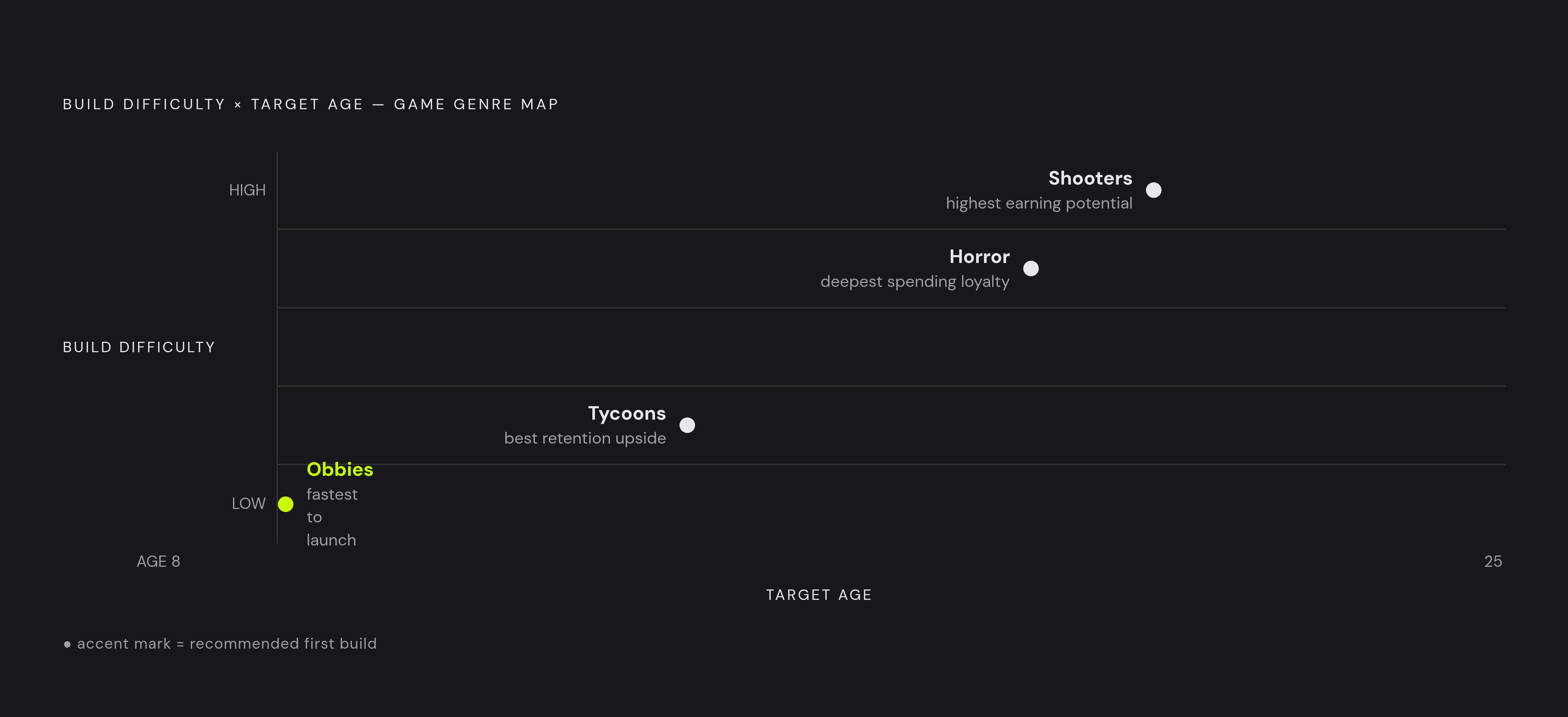
Obbies get you to launch fastest and teach you the most early. Tycoons offer the best retention upside for the effort required. Horror earns the deepest loyalty from players willing to spend. Shooters reward the creator willing to put in the most time, in exchange for an older audience with more spending power, and that's the map. What it looks like applied by an actual teenager is the next piece of evidence.
What happened when a young creator shipped without waiting for perfect skills
BMWLux launched at age 16, squarely inside the 8-to-25 range this entire piece is about. This wasn't a case study about an industry professional with years of technical runway behind them.
The game's core loop was built to be understood instantly by players at the younger edge of the audience, while carrying enough layered progression to hold onto older players who wanted more out of it. That combination, instant readability plus layered depth, is the exact design target this piece has been building toward.
The lesson isn't that anyone who ships a game at 16 will see the same result. That claim wouldn't hold up, and it would be dishonest to pretend otherwise. The real lesson is narrower and more useful: the gap between having an idea and getting it in front of players closed enough that a teenager with a concept could ship it and find out, rather than spending months stacking up technical skills before ever learning whether the idea was any good.
Somebody reading this is already thinking: isn't this just survivorship bias? Most games never get discovered. That's a fair objection, and it deserves a real answer rather than a dodge, which is exactly where the conversation goes next. Survivorship bias doesn't argue against shipping. It argues for shipping fast and cheap, so that when a game misses, the cost of finding that out stays low.
Creator earnings and early shipping
The creator economy behind all of this is real money, and it's also a steep power-law distribution, the kind where a small number of outliers pull the average far away from what a typical creator actually earns. The Developer Exchange program has paid out billions of dollars to creators in recent years, and that figure keeps growing fast year over year. Among the tens of thousands of creators who qualify for cash-outs, the median earner took home a modest sum, while the top tier averaged many multiples of that median.
None of that is a reason to stay away from the platform. It's a reason to treat a first build as a cheap experiment and a learning exercise rather than a business plan with a revenue target attached.
The tooling changes the math on that risk. A first build now takes an hour instead of a month, so a miss costs almost nothing and a creator can try again immediately. The right way to think about a first build: ship it to find out what an audience actually responds to, not to hit a number. Creators who ended up at the top of that distribution got there through iteration, through multiple releases, through spotting patterns across what worked and what didn't, and through sharpening a core mechanic until it landed.
There's also a structural shift working in favor of creators who design across the age range rather than just for the youngest, quickest-click crowd. An updated recommendation algorithm now prioritizes long-term retention for all users, rewarding deeper, longer-form experiences over quick-click games regardless of how old the player is. A creator who successfully holds onto the older segment of the 8-to-25 range earns meaningfully more per dollar of effort spent, simply because older players have more purchasing power behind them. The economics reward depth. The tooling makes building for depth achievable on a first try.
Deciding what to build first
Every piece of this argument points toward the same conclusion: the smartest first build is whichever one ships fastest, teaches the most about a specific slice of this audience, and costs little enough to miss on that trying again is easy. In 2026, that starts with an idea, not a skill set, and the decision comes down to four steps that build on each other in order.
The first step is picking an age anchor instead of trying to cover the full 8-to-25 range at once. A creator should choose the cohort they understand best, the one whose taste they could argue for without needing to research it first, and design for that group specifically. Cross-age appeal grows out of a strong, focused core. It doesn't come from trying to please every age bracket simultaneously, which is the trap the opening section described.
The second step is matching the genre to that anchor using the map laid out earlier. A younger anchor, roughly 8 to 12, points toward an obby: the lowest build cost, the fastest feedback loop, and no economy to design from scratch. A middle anchor, roughly 13 to 15, points toward a tycoon built around a cultural hook, the approach the Steal a Brainrot model proved out by timing its mechanic to a meme cycle. An older anchor, 16 to 25, points toward horror or a social deduction variant, where spending loyalty runs deep and the emotional stakes justify simpler visuals as long as the atmosphere holds up. Shooters stay off the table for a first build and make more sense as a second or third project, once a creator already understands what keeps their specific audience coming back.
The third step is clearing the skill barrier before starting. That means working on a browser-based, AI-assisted platform that handles scripting, modeling, and testing without requiring a Studio installation or a Lua background going in. This is where studs.gg fits naturally: describe the game in plain text, let the platform handle the design, the 3D building, the scripting, and the testing, and end up with a live, published game in roughly an hour. The first build on studs.gg is free, so the cost of a first experiment is zero, and the goal of that first build is to ship and learn. The economics covered above make that case on their own. The tooling just makes it possible to act on it immediately.
The fourth step is treating the recommendation algorithm as a signal. The platform now reads age-related signals differently, surfacing shorter, quicker games to younger users and longer, more involved experiences to older ones. A creator should decide on purpose which signal they're building toward, instead of ending up with a game that reads clearly to neither audience and gets served to no one in particular. Once the skill barrier is gone, the only question left is creative, and the right answer is the simplest version of the best idea a creator has, shipped fast enough to actually find out if it works.