Why Tycoons and Obbies Still Pull the Biggest Crowds for New Creator Games
New creators pick these genres because they're easiest to build and best at keeping players engaged.
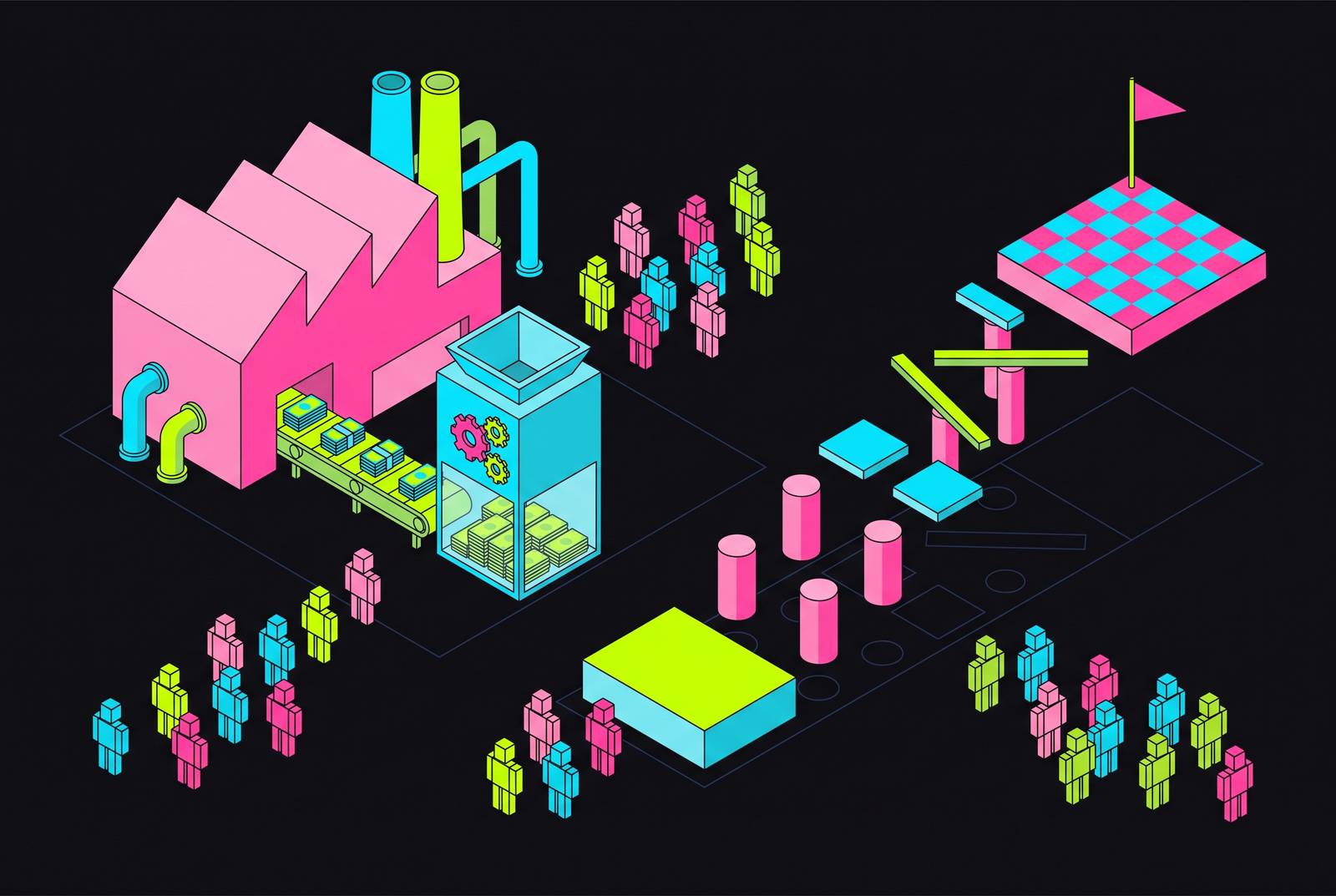
Tycoons and obbies top new-creator launch lists for a structural reason, not a taste reason. These two genres line up on both sides of the equation: they're the cheapest to build, and they're the best at keeping players around once built. Most conversations about genre popularity stop at "players like what they like," which misses the actual mechanism. The real driver is a two-sided match between what a new creator can realistically build and what keeps a player opening the game again tomorrow. Because so many creators are competing for the same slice of attention, genre choice becomes the first real strategic decision anyone makes before writing a single line of script, and the rest of this piece unpacks why obbies and tycoons keep winning that decision.
The lowest-friction genre to build and ship
An obby's core mechanic is jumping between platforms of increasing difficulty, and that's about as simple as game design gets. No combat system to balance. No AI opponents to program. No in-game economy to tune. Compare that to almost anything else on the platform: a basic checkpoint system demands server-side scripting, kill bricks require understanding the Humanoid object and touch callbacks, and a timer means juggling loops, data stores, and UI bindings all at once.
The structure also happens to be modular. An obby is a sequence of obstacles. A creator can build one section, test it, then move to the next without the whole project collapsing if something's unfinished. Shipping ten sections produces a playable game. Shipping three still produces something that functions, even if it's short. A deep well of well-documented community templates means a new creator is customizing a chassis that's already been built, tested, and played by millions of people before them.
Tycoon templates as a ready-made design blueprint
Tycoons earn their spot differently. They aren't simple in the mechanical sense the way obbies are. What makes them accessible is that they come with an established template: place structures, generate income, reinvest, expand. That loop has been documented in tutorials and repeated across so many existing games that a new creator can essentially reverse-engineer the genre by studying a few dozen examples.
The ceiling on that template is high. Theme Park Tycoon 2 has pulled in enormous visit counts by applying the same basic loop with enough creative specificity to stand apart, proving a new creator can anchor to a familiar structure while differentiating almost entirely through theme. Steal a Brainrot pushes the template in a newer direction: a simple tycoon loop of buying characters that generate income, layered with a high-risk PvP twist that lets players steal from each other's bases, riding a meme cycle that spread the game across TikTok on its own. The viral layer got attention, but the base tycoon structure is what carried the game before any of that kicked in.
That same template familiarity cuts both ways. It's what makes tycoons approachable for someone building their first game, and it's also what eventually floods the genre with lookalikes. The tension between approachability and an eventually flooded genre gets its full treatment later in this piece. For now, the point stands: a proven skeleton, dressed in any theme a creator wants, beats a blank canvas every time.
Converting the social pressure of watching others into a retention engine
Obbies keep players coming back through a mechanism that doesn't require any explicit multiplayer design at all: everyone sharing the same space. Every player can see every other player, which turns a single failed jump into a small social event. The player who falls off a platform sees the player who didn't, and that gap pulls players forward instead of pushing them away, mostly because restarting costs almost nothing. Fail, respawn, try again, all within seconds.
Tower of Hell is the clearest long-running proof of this. A randomly generated obstacle tower, an eight-minute timer, and no patience whatsoever for failure. Concurrent player counts have stayed consistently high for years, driven by the social-competitive loop that was baked into the structure from day one, not by content updates or franchise recognition. Random layouts also mean players aren't grinding the same course twice. Each run is a new configuration, which resets the challenge and keeps the motivation cycle fresh. And because sessions are short and restarts are instant, the loop fits naturally into mobile play, which happens to be where most of the platform's audience spends its time.
Progression and social competition through a tycoon growth loop
Tycoons hold players through a different loop entirely: watching their own creation get bigger. The core of a tycoon is aesthetic progression. A base, a park, an empire, visibly expanding on screen. There's no abstract score ticking up somewhere off to the side. The world itself just looks bigger and more elaborate than it did an hour ago, and that's the whole reward.
Social competition appears structurally, through players comparing builds against whoever else happens to be in their server, which creates aspiration without needing a leaderboard or a PvP mechanic bolted on. Grow a Garden makes the case about as well as any example could. Created by a 16-year-old developer, launched in March 2025, and sitting on tens of billions of visits since, it reached platform-defining scale using this loop design alone. No elaborate systems, no complicated economy. Just a clear, visible sense of accumulation. Rebirth and prestige mechanics stretch the loop further: once a player has expanded as far as the map allows, rebirth wipes the visible progress in exchange for a permanent multiplier, which kicks the satisfying early-growth phase back into gear.
Optional monetization and these genres
Both genres monetize in a way that feels like a choice rather than a toll gate, and that distinction protects the experience for everyone who isn't spending money. In obbies, the natural places to charge are stage-skipping, cosmetic trails, and premium difficulty modes. None of those block the core experience. A free player finishes the same course as a paying one, which keeps the social pressure loop intact because everybody is still competing on equal footing.
Tycoons work the same way. Cosmetic upgrades and speed boosts move players through the growth loop faster, but the loop itself stays reachable without spending a cent. Paying compresses time. It doesn't unlock a door that's otherwise sealed shut. That structure lines up well with a younger audience that often doesn't have disposable income to spend, and a genre that can survive on free players keeps the population dense enough for the social loop to keep functioning. For a new creator, there's a practical bonus too: optional acceleration is simpler to build than gated content, currency sinks, or loot systems. The monetization layer matches the rest of the genre's design simplicity.
AI creation tools and the timeline from concept to published game
AI game creation tools take an already-low barrier and push it lower still, shrinking a build timeline that used to run days down to hours or even minutes. Obbies and tycoons benefit the most from this shift because their designs translate into plain language more cleanly than almost any other genre. A creator can describe a theme, candy land, neon city, underwater cave, and get back a working obby complete with gap jumps, kill bricks, lava pits, bouncy pads, and a finish line, without touching a script. That scripting work used to be the wall separating people with ideas from people with published games.
Browser-based AI creation platforms handle design, scripting, and testing on their own, so there's no software to install and no development background required. The barrier drops down to one skill: describing what you want clearly. studs.gg is a working example of this approach. It takes a plain-text description and handles the design, 3D building, scripting, and testing automatically, taking a creator from concept to a live published game in about an hour. Its first build is free, so there's no upfront cost to try it, though further edits or additional builds need a paid Pro plan. Tens of thousands of creators have already used the platform this way.
Supporting tools fill in the rest of the gaps. Artly handles AI-driven game art and thumbnail generation. Nilo generates environments, props, weapons, and characters as 3D meshes. Together, they cover the design tasks that used to require actual artistic skill, not just scripting. None of this is a coincidence of timing, either. Obbies and tycoons are the two genres new creators already reach for first, and they happen to be the two genres that describe themselves in plain language most easily. An obby is a list of obstacle types. A tycoon's layout, what gets built, in what order, at what cost, fits into a paragraph. AI tools didn't create this advantage. They amplified one that already existed.
The real crowding problem
The objection to all of this is fair: tycoons and obbies are commoditized. A generic dropper tycoon or a forgettable obby struggles to get noticed when thousands of similar games already exist. The tycoon genre in particular is maturing toward designs with management decisions, strategic layers, and multiplayer interaction, demands that someone shipping their first game is poorly positioned to meet right out of the gate.
The same template structure that makes these genres accessible also hands new creators their clearest path to standing out. Theme, a meme cycle, a single mechanic twist, none of that requires advanced design skill to pull off. Steal a Brainrot is the proof: a standard tycoon loop, a PvP steal mechanic, and a wave of meme content combined into a breakout hit without inventing a new genre. AI tools sharpen this advantage further. A creator who can generate a working obby in an hour can test five different themes in a week, iterating toward whatever finds an audience faster than any pre-AI creator could ever prototype alternatives.
There's a legitimate concern that AI-generated content will flood these genres with low-effort entries, and that concern applies across every genre on the platform, not just these two. Obbies and tycoons aren't uniquely exposed to that flood. If anything, they remain the genres where a new creator has the best odds of shipping something that actually works, which affects whether that creator gets any real player data at all at the starting line.
Choosing a genre to launch
Everything in this piece points the same direction. These genres are easy to ship. They retain players through loops that have been tested across millions of play sessions. Their monetization protects those loops. AI tools make them the fastest genres to generate from a plain description. None of that is an accident, and none of it is a reason to treat obby or tycoon as the "beginner" choice in some lesser sense.
A new creator's first job is to ship something that functions and holds players long enough to produce real data, and obbies and tycoons clear that bar more reliably than any other genre, given the time and resources a new creator actually has on hand. Theme and creative specificity are the levers that don't require technical skill: a candy-land obby and a neon-city obby fight for completely different audiences despite sharing identical mechanics underneath. Picking a theme with some social traction, a meme, a cultural moment, is the accessible version of the same move the genre's biggest hits make at a larger scale.
AI tools, particularly browser-based platforms that skip installation and scripting entirely, make it realistic to test a theme, publish a game, and iterate toward an audience within a single week. That compresses a feedback loop that used to take months into something a new creator can actually live through and learn from. None of this guarantees a hit. What it does is stack the odds toward shipping a working game and getting real player feedback, and that feedback, not the genre label sitting on the game's thumbnail, is the actual thing a new creator walks away with.