Why Your Subscribers Are Your Best Beta Testers
Your engaged subscribers catch the design problems automated tests and strangers simply cannot.
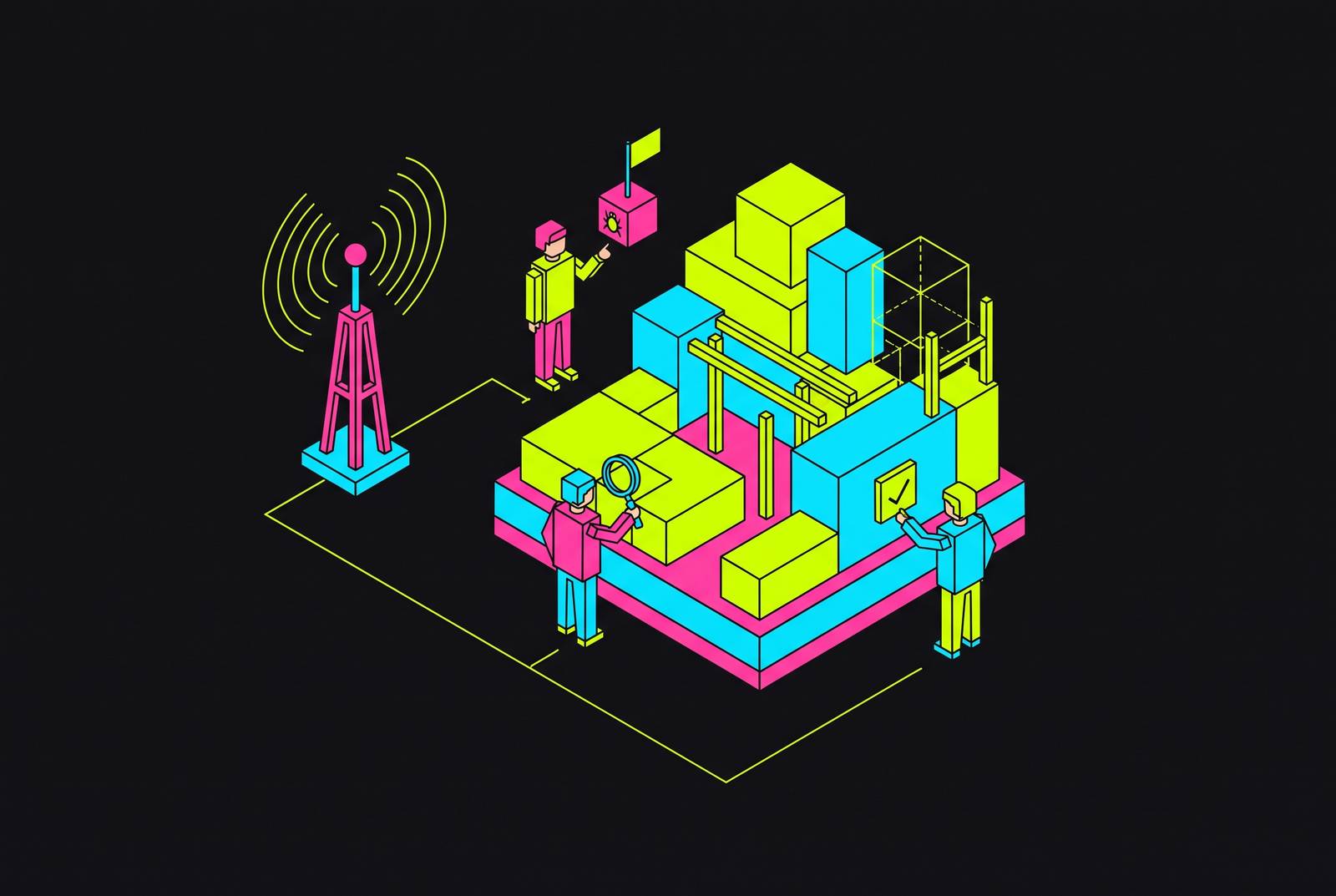
A creator who builds a game cannot playtest it, not really. The piece is about why that's a structural fact, not a personal failing, and what it means for how small studios should actually run quality checks before launch. Anyone who designed every mechanic and mapped every path already knows what's supposed to happen next, so there's no way to experience the surprise, confusion, or delight a stranger feels on first contact. AI tools can now generate code and even run automated playtests against it, but those systems simulate inputs. They don't experience pacing, they don't feel a difficulty spike, and they don't get bored in the way a human gets bored at minute four of a six-minute tutorial. Formal QA, where small teams can afford it at all, is good at catching broken logic: a door that won't open, a quest flag that never fires, a save file that corrupts on exit. It rarely catches the much softer, much more important failure of "this feels wrong," because catching that requires someone who walked in with real expectations and got let down, not a test script running the same inputs a thousand times. That leaves one open question before anything else: who is actually positioned to notice the gap between a game that works and a game that's good?
Why subscribers are structurally different testers
Subscribers answer that question, and not because they're friendly. They answer it because they already know the creative voice they're testing against, so their feedback carries a kind of built-in calibration anonymous testers simply don't have. A stranger pulled in off a forum ad judges the game in isolation: does this work, is this fun, would someone pay for it. A subscriber judges the game against what they expected from the creator specifically. They catch two different categories of problem at once, bugs and also drift from the creator's own stated vision. Laura Beukema, a game designer at Filament Games, has made the underlying point: you can't know for sure if a game will work until someone else tries to play it, and the only way to really know if a game is fun is to see how it's played. Subscribers are the "someone else" with the most relevant context available to any creator, short of hiring a full QA studio. Developer forum beta threads show what that context produces in practice, not vague impressions but specific, locatable issues: a UI tween that stutters, an NPC that anchors to the wrong point on screen, a dagger cooldown that's a half-second off from where it should be. That specificity isn't an accident of personality. It comes from investment. A tester who wants the game to succeed writes three sentences explaining what felt off. A tester who doesn't care closes the tab.
What Subscribers Catch
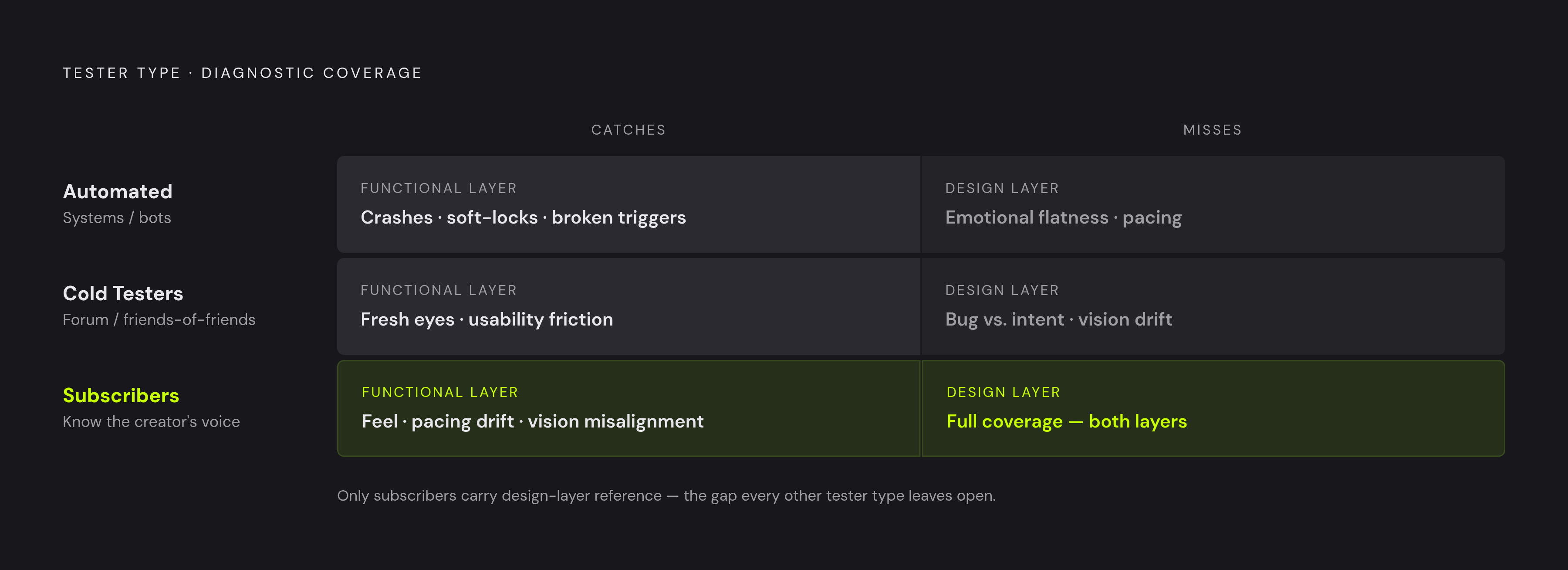
Subscribers are built to stress-test the parts of a game that resist measurement: feel, pacing, and whether a design choice actually fits the thing the creator has been building all along. Automated playtesting agents are useful and getting more capable, but they work by simulating inputs and reading logs, so they're built to catch functional failures: crashes, broken triggers, a boss that soft-locks on a specific frame. They were never built to notice that a game is technically fine and emotionally flat. A title can clear every automated check in the pipeline and still lose a real player in the first two minutes, because "no errors logged" and "fun to play" are not the same test. Cold testers, the friends-of-friends and forum volunteers recruited for a quick round of feedback, bring fresh eyes and genuine usability insight. What they lack is the reference frame to know whether a rough edge is a bug or just a stylistic choice consistent with everything else the creator has made. Subscribers have that reference frame built in. They can say a difficulty spike doesn't feel like the creator's other games, or that the pacing in the middle section lost them in a way the opening never did; that's feedback at the design layer, the kind a creator can actually act on. The beta feedback thread mentioned above is a useful illustration here too: developers in that thread responded to community-flagged issues fast, and the speed of that back-and-forth is part of the value, not a side effect of it. A reasonable objection asks why not just run a wide-open beta and get more feedback, faster, from more strangers. Volume was never the bottleneck. A smaller group of invested testers who can explain why something feels wrong produces more usable signal than a much larger group that can only report that something felt wrong somewhere.
How the feedback loop compounds value before launch
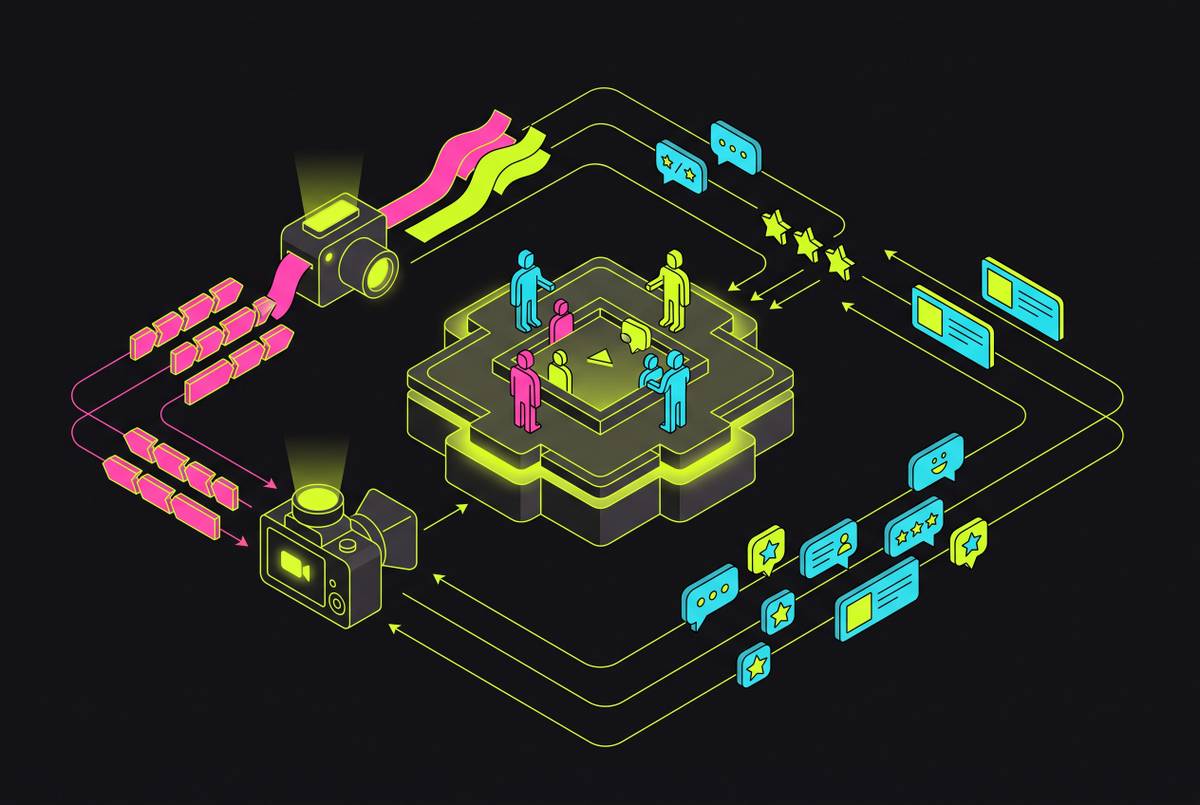
Something shifts when a subscriber sees a suggestion they made actually ship in the game. They stop being an observer of the project and start acting like a co-author of it, and that change in posture has direct, measurable consequences for what happens on launch day. Closed betas, design polls, naming contests, these aren't just engagement gimmicks. They give community members a real stake in outcomes, and a player who watches their idea land in the final build develops a loyalty that a passive follower, someone who just likes a few posts and scrolls on, never develops. That loyalty converts into action at the exact moment it matters most: a Discord of a few hundred genuinely engaged players who buy the game, leave reviews, and share it in the first critical days after launch does more for discoverability than a much larger audience of passive social followers who never engage. Rewarding early subscribers for their input, exclusive items, early access to future betas, in-game credit, keeps the loop running, because participation that feels consequential invites more of it. A subscriber beta run well becomes the engine that decides whether anyone finds the game at all once it's live.
Running a Subscriber Beta in Practice
None of this requires a studio-grade pipeline. Running a subscriber beta takes three things: a defined feedback channel, a clear testing window, and a lightweight process for turning what comes in into something usable. The minimum viable setup is genuinely minimal: a Discord channel or a short survey form, a testing window announced to subscribers ahead of time so they know when their input actually counts, and a standing commitment to respond publicly to what gets raised. Scope matters more than most creators expect. Asking "what do you think?" produces vague, low-signal replies. Asking "does the first level feel too long?" or "does the weapon feedback feel right when you land a hit?" produces answers that can actually be acted on. Processing that feedback used to be the real bottleneck for a solo creator drowning in survey responses, but machine learning tools and basic sentiment analysis now make it realistic to sort signal from noise without reading every single comment by hand, though reliable patterns usually need a lot more than a few dozen responses before they mean anything. Tooling that removes friction from the creative side also pays off here: a creator who isn't burning every evening fighting their own engine has more time left over to actually run a feedback loop properly, which is part of why lighter-weight, more accessible build tools, including platforms like studs.gg, end up mattering for testing capacity as much as for development speed. Iteration speed counts for as much as the volume of feedback received. A creator who ships a fix within days of a bug report keeps subscribers engaged and coming back for the next round of testing.
The one condition that makes subscriber beta testing fail
This entire strategy collapses under one specific condition: a creator who treats feedback as a pat on the back instead of information, hearing the praise, filtering out the friction, and calling it a successful test. The same closeness that makes subscribers such sharp testers can make a creator reluctant to act on hard feedback from people they genuinely like and don't want to disappoint. The fix isn't willpower, it's structure. Define what a successful test actually looks like before the feedback window opens, specific metrics, specific experience milestones, so the bar for "done" is locked in before any comments arrive and can't quietly shift to match whatever the community happens to say. Outside testers, people with zero relationship to the creator, still matter here, because they catch the issues a tight-knit community has already normalized and stopped mentioning. The strongest setup pairs subscriber depth with at least a small layer of cold-tester breadth on top. Closing the loop matters just as much as opening it: telling the testing group what changed, and why, after the round ends is what keeps that same group willing to show up for the next one. A creator who runs this honestly, clear criteria set in advance, hard feedback acted on instead of excused, results reported back without spin, is building a testing relationship that gets stronger with every release. It's that every game after it gets easier to build right.